Most “we need a lift” enquiries are one of three different jobs: moving goods between floors, loading trucks at a dock, or positioning work at a machine. Each calls for different equipment, different civil works and a different power supply. Here is how to tell them apart, with the real numbers from Nandi’s goods lift and scissor lift range.
Three jobs that get lumped together
When a factory owner in Tirupur or Ambattur says “we need a lift”, it usually turns out to be one of three quite different jobs. Sorting out which one you have is most of the selection work.
- Floor-to-floor movement. Fabric going up to a mezzanine checking room, cartons coming down from a second-floor store. Travel is 3–10 m, the load stops at fixed landings, and the platform must be enclosed. This is a hydraulic goods lift.
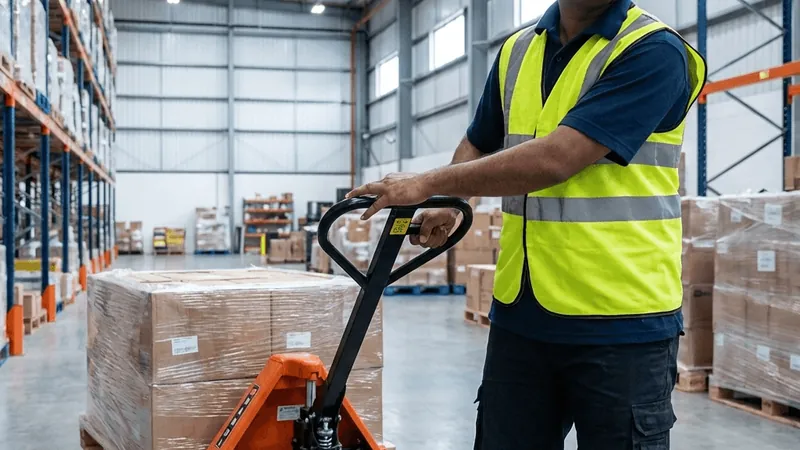
- Dock levelling and truck loading. Raising a pallet from the shed floor to a truck bed 1.2–1.5 m up. Travel is short, loads heavy, cycles frequent. This is a fixed hydraulic scissor lift with AC power pack, usually pit-mounted.
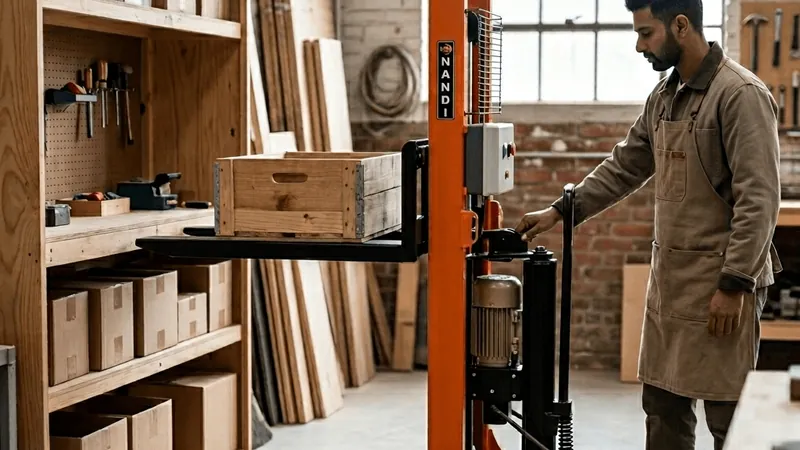
- Work positioning at a machine. Bringing a die or a stack of sheets to working height beside a press. Travel is under 2 m, and the table often moves between stations. This is a mobile scissor table, manual or semi-electric.
A scissor lift cannot do the first job safely, and a goods lift is an expensive way to do the second or third.
A goods lift is not a passenger lift
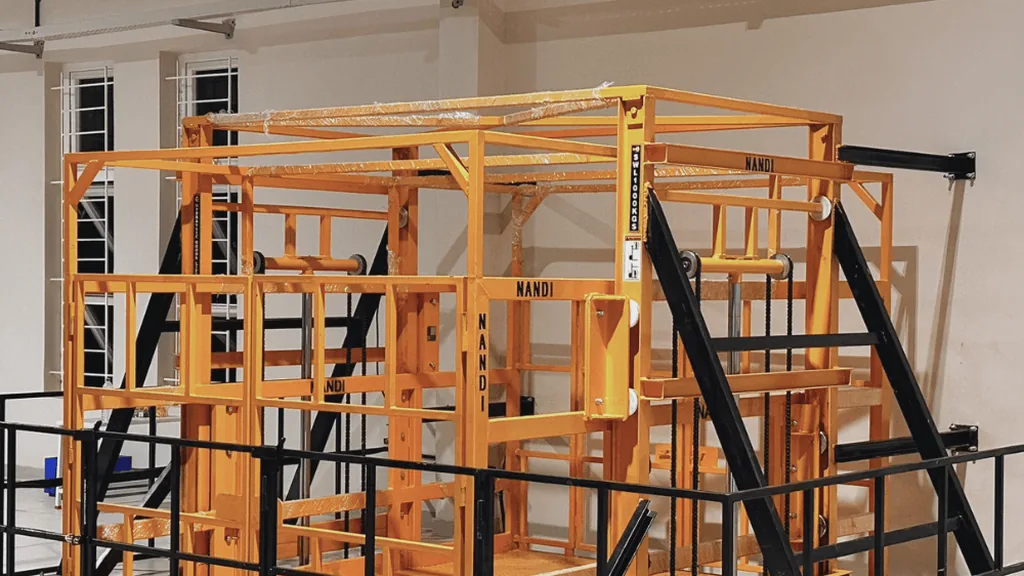
A goods lift carries material with the operator standing outside the cage, calling the platform with push buttons at each landing. It is not built to passenger-lift standards, has no over-speed governor or emergency communication, and must never be ridden. Put a “No Persons” board on every gate and enforce it.
The platform car is meshed at floor level so nothing falls off in travel. Collapsible gates at each landing are interlocked: the lift will not move with a gate open, and a gate cannot open unless the platform is at that landing. Guarding around the travel path stops anyone reaching into the shaft. These are listed as optional, but on a multi-storey installation we would not commission the lift without them.
Power comes from a 3 HP three-phase AC hydraulic power pack driving the carriage up the mast. Lowering is by gravity through a controlled valve, so the pump does not run on the down stroke. That means over 60 percent less power per cycle, and a lighter load on the DG during an outage.
Single mast or double mast
Both variants share the same capacity steps of 500, 1,000, 2,000 and 2,500 kg and serve G+1, G+2 or G+3 levels. The difference is how the platform is guided.
A single mast guides the carriage on one alloy-steel C-section column, with polyurethane side-balancing rollers keeping the platform square. It suits modest platforms, loads that sit close to the mast and travel up to about 6 m, and needs less floor space and wall fixing in an older shed.
A double mast guides the platform on twin columns. Choose it when the platform is wide enough that a cantilevered load would twist a single column, when travel runs towards 8–10 m across G+2 or G+3, or when a 2,000–2,500 kg load sits against the far edge of the platform. Rigidity shows up as less sway at the top landing and less roller wear over years of cycles.
The cheapest lift on paper is the one sized to the load. The cheapest lift over ten years is the one sized to the platform, the travel and the number of cycles a day.
Pit or pit-less scissor lift
A fixed scissor lift for dock work is normally set in a pit so that the closed platform sits flush with the shed floor. A pallet truck rolls straight onto it, the platform rises to truck-bed height, and the load rolls off. The pit is an RCC box sized to the frame, with anchors cast in and a sump if the yard floods in the north-east monsoon.
Where a pit is impossible (a rented shed, a floor with services below, or a slab you cannot cut), the lift sits on the floor and an approach ramp is fitted. Every load then climbs the 500–600 mm lowered height, and the ramp eats about 3 m of floor. Workable for a few cycles an hour; for a busy dock the pit pays for itself.
AC power pack, battery or manual
Three power arrangements; the choice follows the job rather than the budget.
- AC power pack. Fixed installations and heavy loads. The AC scissor lift runs from 500 to 5,000 kg, lifts up to 3,000 mm from ground level, and uses a 3 HP three-phase flange-mounted motor with 12 V DC push-button controls, a 50-litre tank, overload relay and 20 A MCB on the electrical side, relief valve on the hydraulics, and mechanical stoppers with a solenoid release to bring the platform down safely if power fails mid-cycle.
- DC battery. Mobile work positioning where trailing a cable is unsafe. The semi-electric table carries 250 to 1,500 kg on a 1.2 kW lift motor fed by a 12 V, 88 Ah battery with charger, lowered height 450–500 mm, lift height and platform customisable from 500 to 2,000 mm. An AC-fed version with a 2 HP three-phase motor and control panel is available for a fixed station.
- Manual foot pump. Low-frequency positioning, no power needed. Four capacities from 500 to 2,000 kg, a 1,500 × 750 mm platform, 500 mm lowered height and maximum lift of 900, 1,250 or 1,500 mm. Sensible for a dozen lifts a shift, or a wet area you would rather keep electrics out of.
What the buyer owns
The lift arrives factory-tested and dismantled, and is assembled and commissioned at site. Before that day, these are yours:
- Civil works. A grouted, anchored base for the mast; a drained pit for a dock scissor; slab cut-outs at each upper floor sized to the platform plus guard clearance.
- Power supply. A dedicated 415 V three-phase feed with earth, terminated at an isolator near the power pack. If the shed runs on DG, confirm it can start a 3 HP motor on top of existing load.
- Shaft and guarding. A full-height masonry or mesh enclosure around the travel path, or clear space for our guard panels. The lift must not be reachable from a stairway or walkway anywhere along its travel.
- Weather. A canopy over the mast head if the top landing opens to a terrace, and drainage away from the pit.
| Job | Equipment | Capacity | Travel | Power |
|---|---|---|---|---|
| Floor-to-floor, G+1 to G+3 | Hydraulic goods lift, single or double mast | 500–2,500 kg | Up to 10 m, custom | 3 HP, 415 V 3-phase; gravity lowering |
| Dock levelling, truck loading | Hydraulic scissor lift, AC power pack, pit-mounted | 500–5,000 kg | Up to 3,000 mm | 3 HP, 415 V 3-phase |
| Work positioning, mobile, frequent | Semi-electric scissor table, DC or AC | 250–1,500 kg | 500–2,000 mm | 12 V 88 Ah battery or 2 HP AC |
| Work positioning, occasional | Manual hydraulic scissor table | 500–2,000 kg | 900–1,500 mm | Foot pump, none |
Site-survey checklist
Have these ready and the quotation will be right first time.
- Floor-to-floor height at each landing, measured finished floor to finished floor, plus headroom above the top landing.
- Platform size needed: the largest load footprint plus 100 mm each side, and whether a pallet truck rides on with the load.
- Load: heaviest single load, how it is placed, and whether it is centred or against one edge.
- Cycles per hour at peak, and shifts per day.
- Power at site: 415 V three-phase available within 10 m of the power pack location; DG capacity; earthing status.
- Pit possible? Slab thickness, anything running beneath, water table and monsoon behaviour of the yard.
Send us the checklist figures and a couple of photographs of the shed, and our engineers will tell you whether the job is a goods lift or a scissor lift before anyone visits.