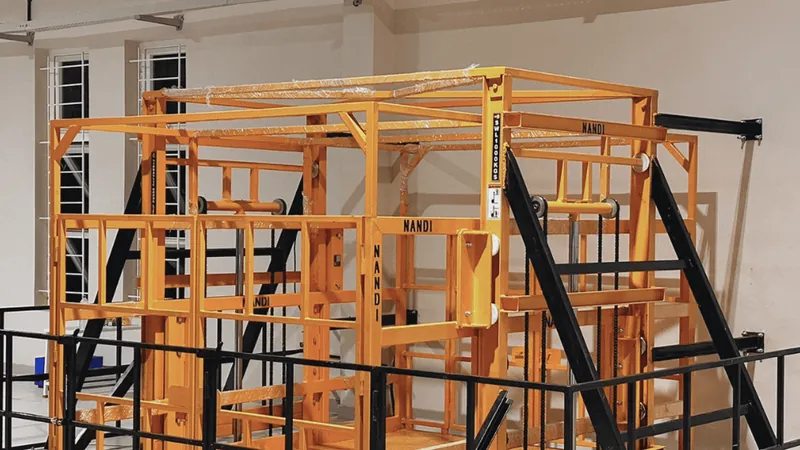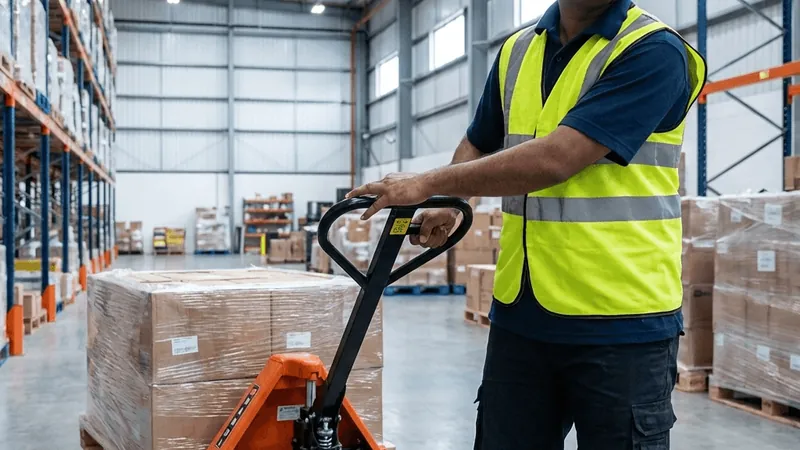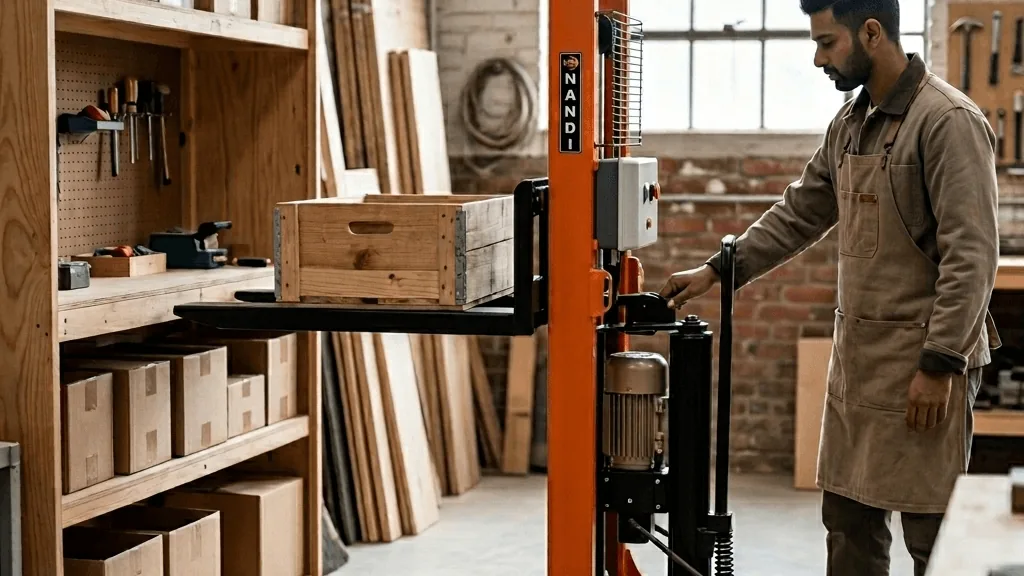
Every stacker in the Nandi range will lift a tonne. What separates them is how many times a shift it happens, how high the load goes, how far it travels, and what power is waiting at the rack. This guide walks through those questions with the real specifications of six machines, so the one you buy is the one your floor actually needs.
Start with two numbers, not a catalogue
Most stacker enquiries we receive open with a capacity: “we need a 1 tonne stacker.” Capacity is the easy part; every Nandi stacker covers 1,000 kg. The two numbers that actually decide the machine are lifts per shift and lift height, followed closely by how far each load travels between pick and place.
- Under roughly 40 lifts per shift, to 2,000 mm: a manual stacker does the job and nothing about it is a compromise.
- 40 to 150 lifts per shift, to 2,000 mm single mast or 4,000 mm double mast: semi-electric. The operator still pushes, but the pumping, which is where the fatigue actually sits, is done by a motor.
- Above 150 lifts per shift, travel beyond 30–40 metres per cycle, heights above 4,000 mm, or three-shift running: battery-operated with powered traction.
These thresholds are guides, not rules. A plant doing 60 lifts a shift but pushing every pallet 80 metres will feel the travel before the pumping, and belongs one step up.
When manual is genuinely the right answer
The Hydraulic Manual Stacker is rated 250 to 2,000 kg, lifts 500 to 2,000 mm from a 100 mm lowered height, and comes in adjustable-fork, fixed-fork and platform variants. The hydraulics use a cartridge-type stationary seal with release and overflow relief valves.
That simplicity is the point. There is no motor to ingest monsoon humidity, no battery to forget on charge, nothing that stops when the DG set hunts for load. For a tool room lifting dies twice an hour, a packing station, or a dispatch bay handling 20 pallets a day, the manual stacker is the correct machine, not merely the cheap one. It stops being correct when an operator pumps a full tonne to 2 metres dozens of times an hour; then you are buying fatigue, and semi-electric pays for itself.
Semi-electric: AC or DC?
Both semi-electric families keep manual travel and add powered lifting. Where the power comes from is decided by your floor plan more than by the load.
Choose the Semi-Electric AC Stacker when there is a 415 V three-phase point within cable reach of the work. The 2 HP flange-mounted three-phase lift motor draws little enough that a modest DG set will not notice it. It ships with a control panel, overload relay, proximity sensors for cut-off positioning and a hydraulic overload relief valve. It suits fixed stations: a rack face, a machine-loading point. Single mast covers 500–2,000 mm; the double mast telescopic reaches 4,000 mm while keeping a lower closed height for doorways.
Choose the Dual Lift AC Stacker when a load left mid-air during a power cut is unacceptable. It pairs the same 2 HP AC power pack with a manual hand pump on a single mast to 2,000 mm, so the line keeps moving through a DG changeover.
Choose the Semi-Electric DC Stacker when the machine must go to the load rather than the other way round. A 12 V / 130 Ah power pack handles a shift of stacking and charges overnight from a 230 V single-phase socket. Single mast lifts 500–2,000 mm and a double mast telescopic configuration is available. The trade-off is charging discipline: someone owns plugging it in every evening, and in humid plants terminals need a monthly check for corrosion.
Single versus double mast is not only a height question. A double mast gives you 4,000 mm with a closed height that passes under a standard shutter, but at 4 metres the load centre and floor flatness matter far more than at 2. Specify lift height honestly, not optimistically.
When to move to battery-operated
The Battery Operated Stacker adds powered traction: a 1.5 kW gear-drive motor, 2.2 kW pump, 24 V / 345 Ah battery with a 30 A transformer-type charger, electromagnetic plus regenerative braking, and a CURTIS controller. Capacities run 500 to 2,500 kg and lift heights up to 6,500 mm across single, double or triple mast, with forks 560 or 680 mm overall and a 90 mm lowered height. Move here when lifts exceed 150 a shift, travel is long, racking goes above 4 metres, or a ramp is involved. A braked machine on a dock ramp is a safety decision, not a comfort one.
The Battery Operated Counter Balanced Stacker is for loads a straddle-leg stacker physically cannot reach. Straddle legs need an opening under the load; closed-bottom pallets, steel bins, dies, coils on skids and block-stacked pallets placed flush against each other leave nowhere for legs to go. The counterbalanced frame carries 500–2,000 kg on 1,200 mm forged forks with a 400–750 mm adjustable fork spread and 2°–4° mast tilt, reaching 1,600 mm on single mast and 4,500 mm on double mast telescopic. The price of no legs is a longer body and a wider turning aisle.
Capacity is the easy question. Lifts per shift, lift height and travel distance are what separate a stacker that gets used from one that gets parked.
Floor and aisle: the Indian warehouse as it is
Spec sheets assume a trimix floor. Many South Indian sheds have older PCC with patches, joints and a dock ramp, which changes wheel choice and machine class:
- Wheels. Nylon rolls easiest and is the default for manual and semi-electric. Polyurethane is quieter, kinder to the floor and grips better where there is oil or fibre fly. Cast iron survives hot or abrasive floors.
- Pallets. Straddle stackers need pallets with clear openings for the legs. Standard IS four-way pallets are fine; closed plastic and steel pallets are not.
- Aisles. For a 1,200 mm pallet, allow roughly 2.0–2.4 m of working aisle for manual and semi-electric single-mast machines, 2.4–2.8 m for a battery straddle stacker, and more for the counterbalanced model. These are planning figures; confirm against the turning radius on the specific spec sheet.
Total cost over five years
Purchase price is the smallest part of the decision on a machine that runs 300 days a year. The table below is illustrative (indices relative to a manual stacker of the same capacity, not quotations), but the shape holds across most plants.
| Item | Manual | Semi-electric AC | Semi-electric DC | Battery-operated |
|---|---|---|---|---|
| Purchase price (index) | 1.0 | 1.6–2.0 | 1.8–2.2 | 4.0–6.0 |
| Energy over five years | Nil | Negligible | Low (overnight charging) | Moderate (daily charging) |
| Battery replacement in five years | None | None | One 12 V battery, typically | One traction battery set, depending on duty |
| Maintenance | Seals, wheels | Seals, wheels, motor and panel checks | Seals, wheels, battery care | Scheduled service: brakes, controller, battery |
| Operator time per lift-and-place cycle | Longest | Medium | Medium | Shortest |
| Works through a power cut | Yes | Only with DG | Yes, on charge | Yes, on charge |
Labour is the swing item. As an illustration only: a plant doing 120 lifts a shift over two shifts and 300 days completes about 72,000 cycles a year. If a semi-electric machine saves 30 seconds of pumping per cycle against manual, that is roughly 600 operator-hours a year. At typical Coimbatore helper wages, the price difference between the two machines is recovered well inside the first two years. The same arithmetic on travel time justifies powered traction at higher volumes.
RFQ checklist
Send these eight items with your enquiry and the quotation can be right first time:
- Heaviest load in kg, and its dimensions and load centre.
- Highest placement height to the top of the beam, plus the lowest doorway or shutter it must pass under.
- Lifts per shift, shifts per day, and typical travel distance per cycle.
- Pallet or load base: IS four-way, closed-bottom, bin, die or unpalletised.
- Power at the point of use: 415 V three-phase, 230 V single-phase, DG-backed, or none.
- Floor: trimix, PCC, epoxy, any ramps or joints, and whether the area is wet, oily or dusty.
- Narrowest aisle the machine must turn in.
- Fork requirement: length, spread and any need for adjustable or platform forks.
Nandi has built stackers in Coimbatore since 1981 to BIS and IS standards, and every model above is configured to your capacity, lift height and forks. Send us the checklist and we will recommend the smallest machine that does the job.