A paper reel or a warp beam is one of the heaviest single items on a mill floor, and one of the easiest to spoil. This guide sets out why cylindrical loads misbehave, which hydraulic trolley suits which job, and the six measurements Nandi’s engineers will ask for before quoting.
Why reels and beams are awkward loads
A pallet is a polite load. It sits flat, its weight is spread over a known footprint, and if you set it down a little roughly the goods inside usually forgive you. A paper reel or a loaded warp beam is none of those things.
- It is cylindrical. Left on a flat floor, a 1,200 mm reel will find the slope. Once a tonne of paper starts rolling, nothing a person can do will stop it safely.
- The mass is high and dense. Jumbo reels from Tamil Nadu kraft and writing-paper mills commonly weigh between one and three tonnes; a fully wound warp beam for a wide loom can approach the same. The centre of gravity is high, and on a part-used reel it is also off-centre.
- Edge damage is scrap. A crushed or nicked reel edge means the outer wraps are slabbed off before the reel can be run, often 20–40 kg of paper per incident. A dented beam flange can put the beam out of true, and every end on it pays for that at the loom.
- The core carries the load. Reels are meant to be supported through the core or cradled along the body, never point-loaded on the wrap. Beams are meant to be carried on the flanges or the barrel, never on the yarn.
Put those together and the traditional methods (two men and a crowbar, a chain around the beam on a forklift, rolling reels down a ramp) look less like economy and more like deferred cost.
What manual handling actually costs
The injuries are predictable: lower-back strain from pushing reels, crushed fingers and feet where a reel is chocked by hand, and the occasional serious incident when a rolling reel meets a person or a machine. Concrete floors suffer too. A hard-edged reel rolled repeatedly over the same path spalls the surface, and a chipped floor makes the next reel harder to control. In older loom sheds around Coimbatore and Tirupur, where floors were laid for much lighter looms, the damage from dragging beams is visible in the trenches worn between warping and weaving.
A hydraulic trolley removes the operator from the load path. The reel or beam sits on forks, is lifted 100 mm clear of the floor, and moves on steel-axled rollers rather than on itself.
Reel trolley, beam trolley or A-frame trolley?
Nandi builds three manual hydraulic trolleys for cylindrical and frame-mounted loads. They share the same pump, cartridge valve and 140–240 mm lift, but they are shaped for different jobs.
| Question | Paper Reel Trolley | Beam Trolley | A-Frame Tow Trolley |
|---|---|---|---|
| Load carried | Paper, board and film reels, cradled in V-forks along the body | Warp beams and large rolls, supported on the flanges or barrel | Loaded A-frames and roll-support frames, lifted at the frame foot |
| Rated capacity | 2,500 / 3,000 / 5,000 kg | 2,500 / 3,000 / 5,000 kg | 5,000 kg |
| Fork length | Up to 3,500 mm | Up to 2,800 mm (single roller) or 4,500 mm (double roller) | 650 × 300 mm body, no forks |
| Load size range | Reel OD 600–1,500 mm | Beam flange 600–1,500 mm | Minimum height 235 mm under frame |
| Typical location | Reel store, unwind stand, printing and converting lines | Warping room, sizing, loom shed | Textile processing and storage sections |
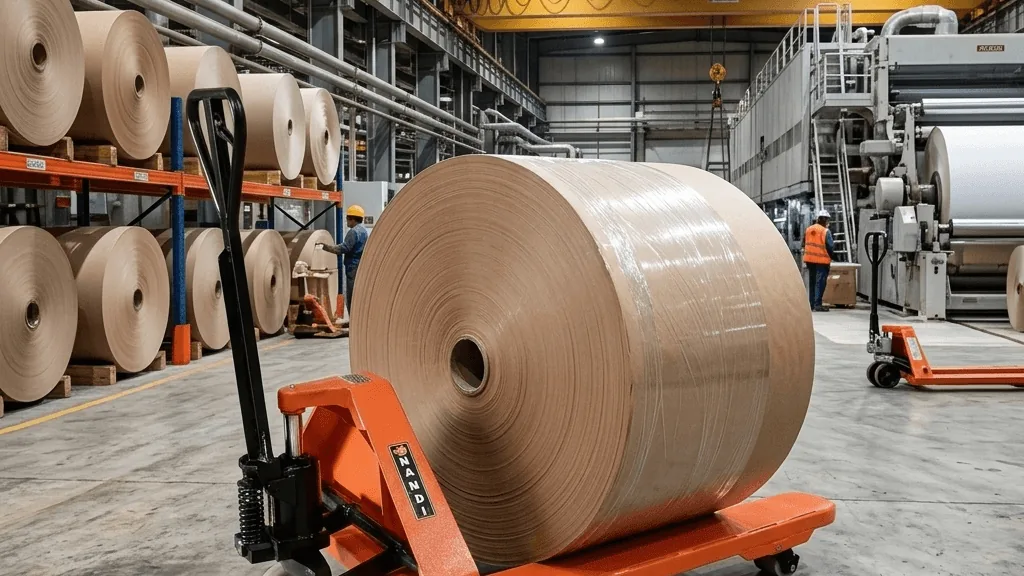
The Hydraulic Paper Reel Trolley uses 160 mm-wide reinforced V-forks so the reel rests in the vee and cannot roll off. Fork length and spacing are cut to your reel diameter band (600–900, 900–1,200 or 1,200–1,500 mm), and the four Ø80 × 60 mm load rollers keep the deck low enough to slide under a reel standing on its side.
The Hydraulic Beam Trolley shares the V-fork construction but is dimensioned for warp beams, with forks set to flange widths from 600 to 1,500 mm. It comes in two bracket arrangements, discussed below.
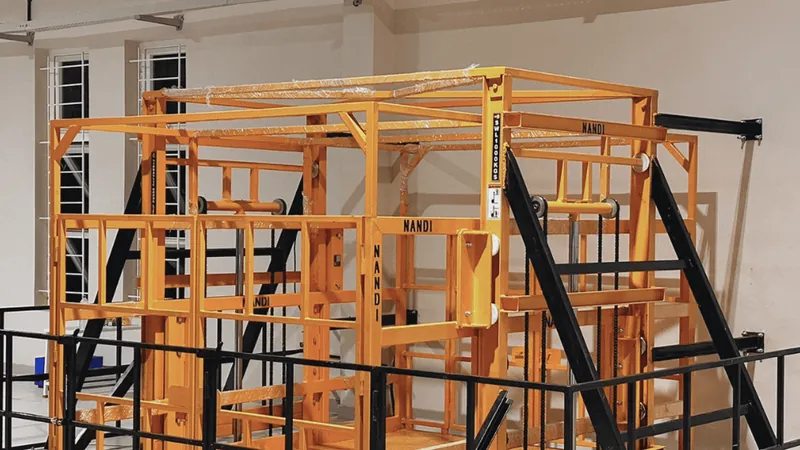
The A-Frame Tow Trolley does not touch the roll or beam at all. It slides under the support point of a loaded A-frame, lifts it a few millimetres on its hydraulic piston, and the whole frame is towed on Ø190 mm nylon wheels. If your fabric rolls or beams already live on frames, this is the cheapest way to move them without unloading.
For anything that arrives on a pallet, such as reams, cones or cartons of finished fabric, a standard Hydraulic Pallet Truck at 2,000–5,000 kg is the right tool, and cheaper. Do not try to move a bare reel on one; the flat forks give it nothing to sit in.
Single-roller or double-roller beam trolley
The single-roller bracket trolley carries the beam on forks up to 2,800 mm long, with two Ø80 × 60 mm load rollers per fork. For most spinning-mill and narrow-loom beams this is sufficient and the shorter forks turn more easily in a crowded shed.
The double-roller bracket adds a second roller pair (Ø80 × 85 mm at the front and Ø80 × 70 mm at the rear) so the load is spread over two points along forks up to 4,500 mm. Choose it when beams are long (wide-width weaving, technical textiles), when the beam is heavy for its length, or when the route includes tight turns where a long single-support fork would try to tip.
A trolley that fits the load is a safety device. A trolley that nearly fits the load is a new way to damage it.
Floors, doorways and gradients
With the forks lowered, all three trolleys sit at 140 mm (235 mm for the A-frame unit). Check that the reel or beam you intend to lift actually clears that height where it is stored; a reel standing on a 100 mm dunnage batten may not.
Doorways need to pass the trolley plus load, not just the trolley. A 1,500 mm reel on a 3,500 mm fork set is a long, wide object that does not corner like a pallet truck. Walk the route with a tape before ordering.
Nylon load rollers are standard and suit smooth concrete and epoxy. Broken or trowel-finished floors are better served by polyurethane, which is quieter and kinder to the surface. Ramps are the real limit on a manual trolley: at 5,000 kg a 1-in-20 gradient is hard work and anything steeper wants either a second operator, a winch, or a semi-electric unit.
What to measure before you enquire
- Reel or beam outside diameter: minimum and maximum, because the fork spacing is cut to the range, not to one size.
- Core inside diameter and type for reels (76 or 152 mm are common), and flange diameter and barrel length for beams.
- Width or length of the load along its axis. This sets the fork length.
- Maximum weight, including a margin for the heaviest grammage or the fullest beam you ever run.
- Floor type and condition: epoxy, trowelled concrete, tiles, expansion joints, drain covers.
- Ramps and thresholds along the route, with gradient and height, plus the narrowest doorway.
Send these six items and Nandi can confirm the capacity class, fork length and roller type in one exchange rather than four.
Handling practice
- Lift only as high as you need. The 100 mm stroke is for clearing the floor; travel at minimum height to keep the centre of gravity low.
- Centre the load on the forks. On a part-used reel, the heavy side should sit over the load rollers, not the steering wheels.
- Pull, do not push, on the level; face uphill on any gradient so the load is never between you and the slope.
- Chock every reel that comes off the trolley. A pair of timber wedges costs less than one slabbed wrap.
- Inspect the V-fork faces weekly. A burr on the fork marks every reel it carries.
- Keep the hydraulics topped up and the cartridge valve clean. A trolley that creeps down under load will set a beam on the floor when you least expect it.
Tell us your reel or beam sizes, weights and floor conditions and we will recommend the right trolley, fork length and roller type, built in Coimbatore to BIS standards.