Every pallet that detours to the floor scale costs a walk, a wait and a second lift. A pallet truck with load cells in the forks removes that detour, but only if you understand what its reading means, where it is good enough, and how to keep it honest. A practical guide for stores and dispatch managers.
The walk nobody costs
Ask a stores supervisor how long it takes to weigh a pallet and the answer is usually “a minute”. It is not. The pallet has to be picked up, pushed to the platform scale, set down square on the plate, read, picked up again and pushed to where it was actually going. If somebody else is already on the scale, the operator waits.
Some illustrative arithmetic, and it is only that, so plug in your own numbers. Suppose the floor scale sits 40 m from the receiving bay. A manual pallet truck under load moves at a walking pace of roughly 1 m/s, so the detour is about 80 s of travel, plus perhaps 60 s to position, settle, read and note the weight, plus a second lift and lower. Call it three minutes per pallet. At 60 inbound pallets per shift that is three man-hours a day spent walking to a scale, or close to one operator’s full shift over every three days. Weighing on the truck itself brings that to roughly the time it takes the display to settle: a few seconds, while the pallet is already on its way.
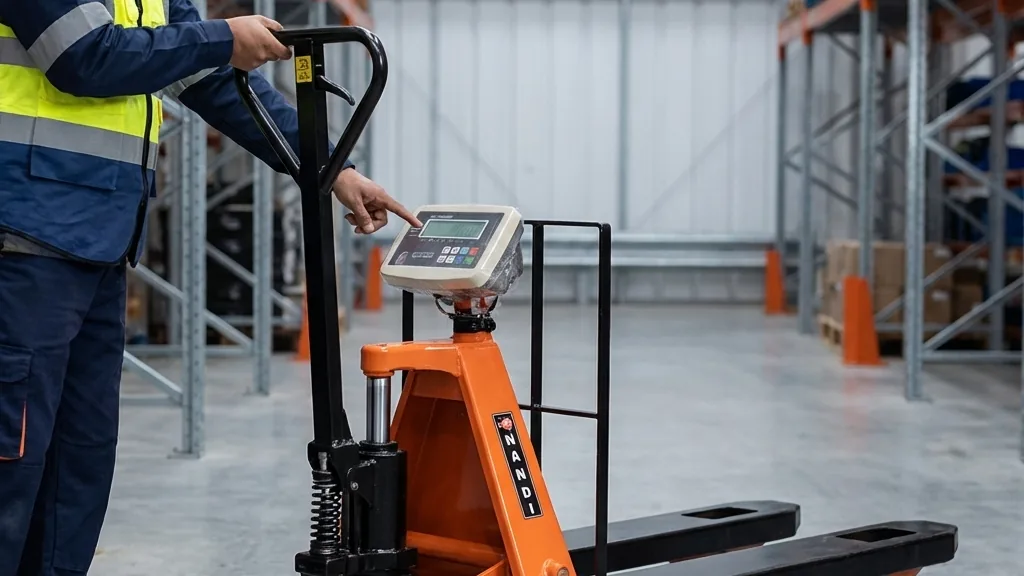
The Nandi Hydraulic Pallet Truck with Weighing Scale is a standard 1,150 mm-fork manual truck rated for 2,000 or 3,000 kg, with four load cells built into the fork assembly and a battery-backed display. Mechanically it behaves like the plain Hydraulic Pallet Truck; the difference is that it tells you what it is carrying.
Where it matters most
- Inbound goods receipt. Weighing every pallet as it comes off the lorry lets you raise a short-shipment claim the same day, with the weight recorded against the consignment. Once material has gone into racking the argument is lost.
- Dispatch and freight billing. Transporters bill on declared weight and re-weigh at their hub. A recorded weight at your dock is your evidence when the invoice disagrees, and it keeps you inside vehicle axle limits.
- Batch and recipe weighing. In textile dyeing and chemical stores, drums and bags are often moved to the weigh-room simply to confirm a charge quantity. A scale truck lets the operator weigh the pallet of dye or auxiliary at the rack and take only what the recipe needs.
- Scrap and yarn waste accounting. Hard waste, soft waste and sweepings in a spinning mill, or offcuts and turnings in an auto-component shop, are sold by weight. Weighing bins as they leave each department closes the loop on where the loss is coming from.
- Cotton bale receipt. Bale weights vary and moisture affects them. A truck that weighs bales as it moves them to the mixing area gives a lot-wise tally without a second handling step.
What the accuracy figure actually means
Fork-mounted scales are commonly quoted at around ±0.1 per cent of the applied load. On a 2,000 kg pallet that is ±2 kg; on a 500 kg pallet it is ±0.5 kg. Confirm the figure for the model you are buying on the spec sheet; do not assume it.
Do not confuse this with resolution. A display that reads in 1 kg or 0.5 kg steps is showing you resolution, which is how finely the number is divided. Accuracy is how close that number is to the truth. A scale can display to 0.5 kg and still be 3 kg out. When you specify, ask for both, and ask for accuracy as a percentage of load or as a fixed figure, not as “high precision”.
Equally important: a scale pallet truck is a process weighing instrument for internal use: stock control, batch confirmation, claims evidence, waste accounting. If a weight is the basis of a sale or purchase invoice, Indian Legal Metrology rules require a verified and stamped instrument. Unless a specific truck is supplied with that certification, treat its reading as your internal record and let the certified weighbridge or platform scale remain the instrument of trade.
A display that reads to 0.5 kg is telling you its resolution. Only a check-weight tells you its accuracy.
Calibration, drift and temperature
Load cells drift. Shock loading, a hard drop of the forks, a dyehouse that swings from 18 °C at 6 a.m. to 38 °C by afternoon: all of it moves the zero and, to a lesser degree, the span. A practical routine:
- Daily zero check. Lift the empty forks, let the reading settle, and confirm it reads zero. Re-zero if it does not.
- Weekly check-weight. Keep a known mass (a cast test weight, or a pallet whose weight has been fixed on a certified scale) and log the truck’s reading against it. Pick something near your typical working load, not a 20 kg block on a 3,000 kg truck.
- Annual calibration. Have span calibration done with traceable weights and keep the certificate with the truck’s file.
- After any incident. A collision, a drop or a fork overload calls for a check-weight before the next reading is trusted.
Battery, display and data
The Nandi scale truck runs its indicator on four 6 V / 4 Ah batteries, giving up to five hours of backup on a charge of around eight hours, with automatic switch-off to protect the pack. That suits a shift where the indicator is switched on to weigh and off between moves; if you expect it to run continuously across a double shift, say so at the RFQ stage. The truck itself remains manual hydraulic, so a flat indicator battery never strands a pallet.
Display-only is enough for most stores use. Where a paper trail matters (dispatch, waste sales, dye recipes), specify the built-in or wireless printer option so the weight ticket is generated at the point of weighing rather than copied from the display by hand. Copying is where the transcription errors live.
For high-throughput sites that already run a Battery Operated Pallet Truck, the weighing question is the same; discuss with us whether a scale fork fits the duty cycle you have in mind.
Practices that ruin a reading
- Weighing on a ramp or dock leveller. Even a small slope shifts load between the cells and the reading goes with it. Weigh on level floor.
- Uneven or broken floors. If one fork tip is in a pothole the pallet is not sitting on the cells the way they were calibrated. Move a metre and re-weigh.
- Dynamic loads. Read the display with the truck stationary and the load still. A sloshing drum, a swinging bale or a pallet still oscillating after lifting will not settle to a true figure. Wait for the stable indicator.
- Pallet overhanging the forks. Loads that extend well past the 1,150 mm fork tips or sit off-centre across the 175 mm gap load the cells asymmetrically. Centre the pallet and push fully home.
- Weighing with the forks on the floor. The cells only see the load when it is lifted clear. Raise, settle, read.
- Debris on the forks. Strapping, spilt fibre or packed-in dust under the load plate adds to the tare and masks the zero.
Choosing between the options
| Factor | Fixed floor scale | Scale pallet truck | Bench / platform scale |
|---|---|---|---|
| Where weighing happens | At the scale; goods travel to it | Wherever the pallet is | At the bench; goods travel to it |
| Typical capacity | 1,000–5,000 kg and above | 2,000 / 3,000 kg | 30–600 kg |
| Handling per weighment | Two lifts plus travel | None extra | Manual off-loading of items |
| Accuracy class | Highest; can be verified for trade | Process weighing, around ±0.1 per cent typical | High for small items; can be verified |
| Legal-for-trade | Yes, if stamped | Internal use unless certified | Yes, if stamped |
| Floor and civil work | Pit or ramp, level pad | None | None |
| Best suited to | Trade invoicing, weighbridge cross-check | Receipt, dispatch, batch and waste weighing on the move | Small parts, samples, lab and packing |
Most plants end up with all three. The scale truck does not replace the certified platform; it takes the routine, high-frequency weighments off it so the fixed scale is free for the ones that matter legally.
RFQ checklist
- Rated capacity: 2,000 or 3,000 kg, and your typical load, so accuracy can be judged at the weight you actually handle.
- Accuracy and resolution, stated separately, with the load at which accuracy is quoted.
- Tare, zero and hold functions on the indicator; whether accumulation or piece-counting is needed.
- Printer: none, built-in or wireless, and what the ticket must carry.
- Battery duty: hours of indicator use per shift and access to charging.
- Fork dimensions against your pallets: 1,150 mm length, 565 mm overall width, 195 mm fork width, 175 mm gap, 95 mm lowered height as standard.
- Environment: temperature range, humidity, wash-down, fibre or chemical exposure; wheel material to suit the floor.
- Calibration: initial certificate, recommended interval, and who supports recalibration in your area.
- Trade use: state plainly whether any weight will be invoiced from, so certification can be discussed rather than assumed.
Tell us what you weigh, how often and where the floor scale is today. We will help you work out whether a scale pallet truck earns its place on your floor.